BRAND GUIDELINES
The Plansmith brand.
One visual language, two modes. Pine primary, brass accent. The planning agent, built by BrainGrid. Everything on this page also ships as machine-readable tokens for AI agents and developers.
WHAT WE STAND FOR
Three things make a plan good. Context. Clarity. Collaboration.
Bring the context. Spec what matters. Plan it together.
Context
Bring your code and your business context.
More context. Better plans.
Clarity
Spec what matters.
Interviews you, up front, before anyone builds.
Collaboration
Plan it together.
The plan gets good in the open.
Pine is primary
The deep green is the core identity: primary actions and ink in light mode. Always a foreground, never a background or a surface.
Brass is the accent
Antique brass is the single secondary accent. The identity pop, used sparingly, the way lime works against jungle. Muted so it reads gold, not orange.
Neutrals from radial
Backgrounds and surfaces are radial's warm neutrals: cream in light, charcoal in dark. One set of semantic tokens; only the mapping changes.
Crisp, not soft
1px borders, near-invisible shadows, square corners, high contrast.
Quiet confidence
No hype, no exclamation marks, no superlatives that outrun the product. State the bet; let the Specs prove it.
Concrete over abstract
SPEC-4, the AC3 criterion, "Pushed 14 issues to Linear." Never free-floating "insights" or "workflows".
LOGOS AND SYMBOLS
The Nodes mark.
The mark is "Nodes": four node-and-connector elbow units in pinwheel rotation. Specs are nodes, dependencies are the connectors; the plan is a connected graph. It shares construction DNA with the BrainGrid parent mark.
Light mode

Dark mode
"Plan"
--color-foreground
"smith"
--color-muted-foreground
Nodes mark
pine on light, brass on dark
Download the lockup

Download the mark



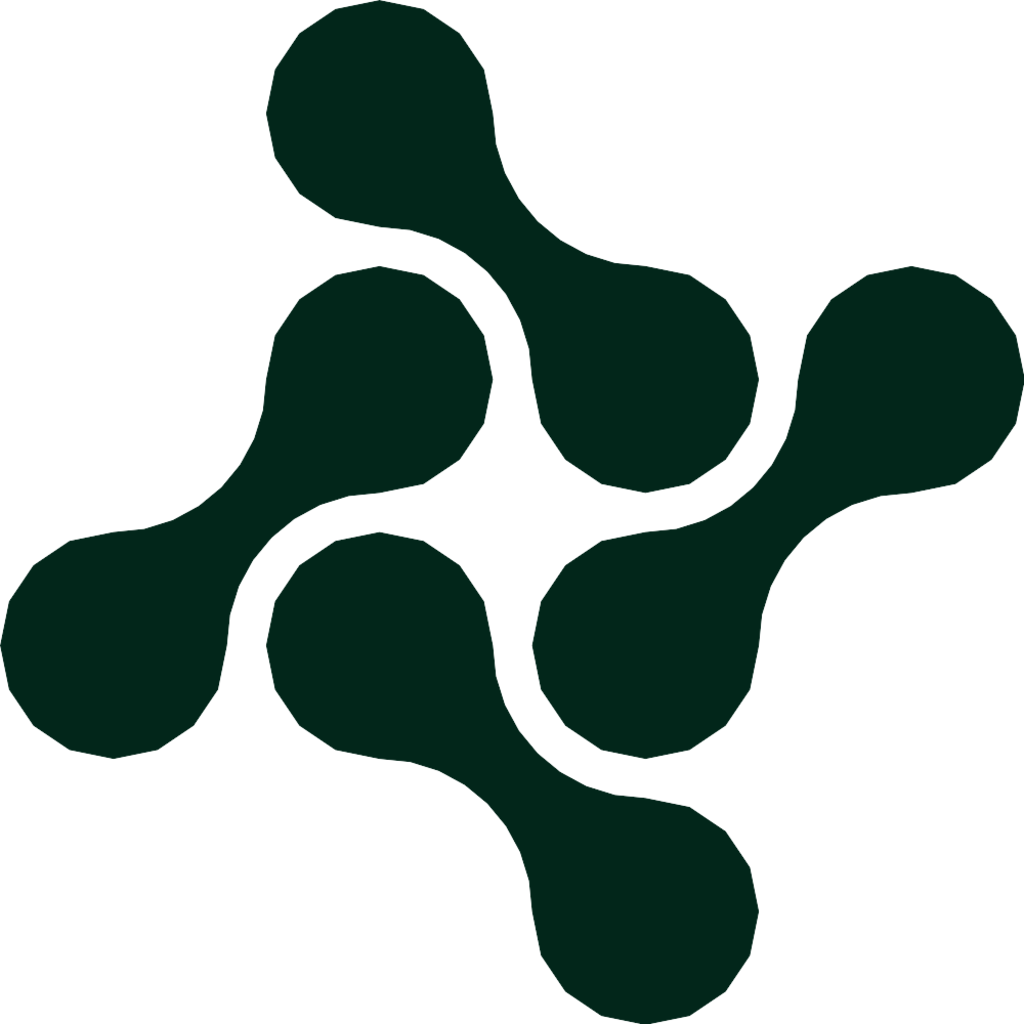








- The mark follows contrast: pine on light surfaces, brass on dark. Brass on cream is too washed out.
- Single color always, via currentColor. Never recolor into a second hue, outline, distort, or add effects.
- The wordmark is two-tone: "Plan" in the foreground token, "smith" in muted-foreground, Besley SemiBold outlined to paths. Wordmark only; UI text stays Geist.
Proposed: 16px minimum for the mark; the wordmark never smaller than text-lg.
OUR NAME
Plansmith.
Always "Plansmith": one word, capital P only. Never "PlanSmith", "Plan Smith", or "plansmith" in prose. The wordmark splits the two-tone "Plan" and "smith", but the name is one word.
The wordmark is Besley SemiBold, a Clarendon born of the type foundries: forged type for a smith. It ships outlined to paths; UI text stays Geist.
COLOR PALETTE
Pine primary, brass accent.
Pine is the primary and carries the identity. Antique brass is the single secondary accent, used sparingly. Semantic token names stay constant; only the mapping changes between light and dark.
Identity
Pine
#02261a
--color-pine
Antique Brass
#c79a46
--color-accent
Brass Ink
#1a1205
--color-accent-foreground
Light mode
Cream
#fbf6eb
--color-background
Warm white
#fffdf7
--color-card
Sand
#f2ece0
--color-elevated
Border (light)
#e0dace
--color-border
Foreground (light)
#1d1b1a
--color-foreground
Primary (light)
#1d1b1a
--color-primary
Muted (light)
#68625b
--color-muted-foreground
Success (light)
#2f7d4f
--color-success
Destructive (light)
#b3462f
--color-destructive
Dark mode
Charcoal
#1d1b1a
--color-background
Dark surface
#262422
--color-card
Dark elevated
#312f2c
--color-elevated
Border (dark)
#383633
--color-border
Foreground (dark)
#ebe9e7
--color-foreground
Primary (dark)
#ebe9e7
--color-primary
Muted (dark)
#a8a49f
--color-muted-foreground
Success (dark)
#5fb37a
--color-success
Destructive (dark)
#d96a5a
--color-destructive
TYPOGRAPHY
Geist, DM Sans, Geist Mono.
Geist is the brand face and the wordmark. DM Sans sets app body text. Geist Mono sets code, data, and SPEC-n id chips.
Geist
font-marketing
The brand face for set text: all headlines and body. One face for UI across the site and the parent.
Weights: 400, 500, 600, 700
DM Sans
font-body
App body face. Product UI text.
Weights: 400, 500, 600, 700
Geist Mono
font-mono
Code, data, and tabular figures. SPEC-n ids and effort/readiness chips.
Weights: 400, 500
Besley
none
The wordmark face, and only the wordmark: a Clarendon born of the type foundries, forged type for a smith.
Weights: 600
Turn business requirements into a plan.
The planning agent for the business side of software. Plan with all your context.
HOW WE SOUND
Quiet confidence.
The Translator: someone who has lived both sides of the handoff, empathetic to the operator, credible with engineers. Not a guru, not a futurist. Speaks from specifics: real tickets, real bounce-backs, real rewrites.
Voice markers
- Craft verbs: shape, forge, ground, score, hand off. The plan is worked like material.
- Quiet confidence. No hype, no exclamation marks.
- Short sentences for emphasis. "Rough. Shaping. Ready." "Handed off, not handed back."
- Second person, singular team: your dev team, your issue tracker, your context.
- Plain words. If a cold visitor cannot parse a sentence, it loses.
- User verbs only: describe, review, refine, hand off. The agent reads code; the user never does.
Lines that land
- Your dev team doesn't need more tickets. They need better ones.
- The handoff is where good requirements die.
- Engineering got agents. Now it is your turn.
- Rough. Shaping. Ready.
- Handed off, not handed back.
- Business requirements in. Build-ready out.
- Where the plan gets good.
Never use
WORDS MATTER
The ontology is locked.
Team, Project, Plan, Spec. Never epic, requirement, or artifact. A Spec is the atomic unit.
Preferred
- Team -> Project -> Plan -> Spec
- The ontology, locked. A Spec is the atomic unit; SPEC-n ids appear in visuals deliberately.
- Spec
- The buildable unit: numbered acceptance criteria, effort, readiness, and "needs first" links. Capital S.
- build-ready
- Always. It replaces dev-ready everywhere.
- business requirements
- What the user brings; never "ideas".
- issue tracker
- Always the full phrase, never bare "tracker". A respected destination and the plan of record.
- Connector
- Always. Never adapter, never integration.
- the planning agent
- The category. The planning agent for the business side of software.
Avoid
- epic, requirement, artifact
- Ontology lock: only Team, Project, Plan, Spec.
- ticket (as our own noun)
- Tickets and issues live in the issue tracker; Specs live in Plansmith.
- integration, adapter
- It is a Connector, always.
- dev-ready
- Replaced by build-ready; sweep on contact.
- ideas
- Reads vibe-coding-ish; this persona owns business requirements.
- tracker (bare)
- Plain business words: issue tracker.
- Spec tree
- Retired from customer copy; readers see Specs and Plans.
- free, Get started free
- No free tier and no "free" language.
Labels, not numbers
Readiness: Rough, Shaping, Ready. Effort: Low, Med, High. Render the labels, never the raw 1 to 5 numbers.
Connectors
- Project Management: Linear, Jira, Asana, Radial: where plans land.
- Code: GitHub, GitLab, Bitbucket: what the agent reads, read-only.
- MCP: Everything else: any source that speaks MCP, such as Notion, Confluence, Google Drive.
USAGE GUIDELINES
Do and don't.
Do
- Use semantic tokens only (bg-background, text-primary); the mapping, not the component, changes per mode.
- Take backgrounds and neutrals from radial: cream in light, charcoal in dark.
- Pine is the primary; brass is the single secondary accent, used sparingly.
- Use 1px borders for separation; keep shadows near-invisible.
- Square corners across the system.
- Render the mark in currentColor; brass for the identity pop.
- Split the wordmark two-tone: "Plan" in foreground, "smith" in muted-foreground.
- Render readiness as Rough, Shaping, Ready and effort as Low, Med, High, never raw numbers.
- Pair any code-access claim with: read access only; it never changes a line.
Don't
- Never write a dark: prefix or hardcode palette colors; the theme guard fails the build. Modes are handled by the tokens.
- Never use the green as a background or a surface; it is a foreground color only.
- Never let brass drift vivid; keep it muted so it reads gold, not orange.
- Never promote brass to the primary; it stays the secondary accent.
- Never add a second accent color or a gradient on a UI surface.
- Never recolor, outline, distort, or add effects to the mark; single color always.
- No em dashes anywhere in site copy.
- Never use the hype words in the banned list; state the bet plainly instead.
- No fabricated customers, logos, testimonials, case studies, or metrics; no compliance claims.
- Never disparage issue trackers; the enemy is the handoff.
FOR AI AND DEVELOPERS
Machine-readable tokens.
Every token, font, and copy rule on this page ships as data, derived from one source of truth. The system is two-tier: semantic token names stay constant, and the mode (light or dark) decides the mapping. Fetch whichever format your tool reads.
curl https://www.plansmith.co/brand.md
Parent brand: braingrid.ai/brand.